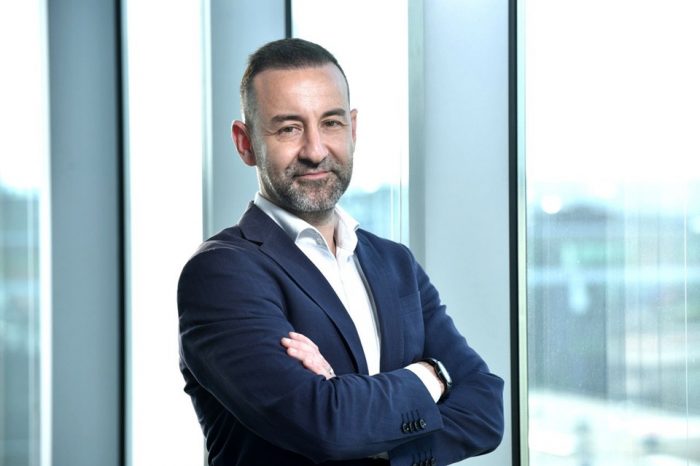
🎙️Andrei Savin, CEO of BRINEL | IQANTO: Infrastructure and traditional data centers are rapidly evolving into AI Factories, especially where data sovereignty and regulatory compliance are critical
 Magda Purice
Posted On March 12, 2026
Magda Purice
Posted On March 12, 2026

Outsourcing Today, the business services industry’s integrated networking and news platform, continues its interview series with leaders shaping the future of business services and related sectors. We explore key perspectives on the year ahead, strategic priorities, and growth opportunities.
Read below the key standpoints and perspectives of Andrei Savin, CEO of BRINEL | IQANTO
- In business transformation, AI is no longer an add-on: in ERP & CRM, intelligence is already embedded at product level, enabling automation, prediction, and decision support by default.
- AI is a business transformation initiative
- AI is not a shortcut to intelligence; it is a mirror of how intelligent your organization already is.
- Education, empathy, and intentional leadership create cognitive trust and emotion is the missing layer in most enterprise AI transformations
Power words for 2026: Clarity. Execution. Impact.
About BRINEL | IQANTO:
Part of the iQanto division of SNEF Groupe, BRINEL | IQANTO delivers measurable business value through AI, Hybrid Multi-Cloud, and Cyber Resilience. The company’s focus is on design, build, and operate secure, scalable digital foundations, from AI‑ready infrastructure and sustainable data centers to hybrid multi‑cloud platforms, cyber‑resilient architectures, digital workplace solutions, modern applications, and Dynamics 365 ERP transformation.
How is the AI-based technologies changing your company’s competitive edge in 2026?
In 2026, AI-based technologies have fundamentally reshaped BRINEL|IQANTO’s competitive edge by accelerating our evolution from a classic IT&C systems integrator to a value-added service provider, a move we made ahead of the AI wave. Our edge comes from having anticipated this shift: we didn’t just adopt AI, we re-architected our business around it, transforming integration into measurable business value. We fast-forwarded our strategy and pivoted the entire portfolio toward Data & AI, positioning BRINEL | IQANTO as an AI integrator.
Infrastructure and traditional data centers are rapidly evolving into AI Factories, especially where data sovereignty and regulatory compliance are critical. In these environments, we design and integrate scalable, secure, AI‑ready platforms that can host advanced analytics, GenAI, and industry‑specific workloads.
In business transformation, AI is no longer an add-on: in ERP & CRM, intelligence is already embedded at product level, enabling automation, prediction, and decision support by default.
In cybersecurity, AI gives us access to advanced big data algorithms, trend analysis, and predictive insights, shifting security from reactive defense to proactive risk management.
At industry level, we build tailored Data & AI use cases for sectors such as agriculture, manufacturing, and production directly tied to operational efficiency, cost optimization, and competitive differentiation.
What’s the biggest misconception business leaders still have about AI?
The biggest misconception is that AI is a technology you buy, not a capability you build. In reality, AI is a business transformation initiative. The best results come when leaders treat AI as a strategic capability that requires ownership, change management, and a long-term vision, not just experimentation.
Another persistent myth is that AI projects fail because the technology “isn’t ready.” In practice, most failures come from predictable cognitive and strategic biases: overestimating organizational readiness, assuming AI is universally applicable, prioritizing data volume over data quality and governance, and treating AI like traditional software implementation.
AI is not a shortcut to intelligence; it is a mirror of how intelligent your organization already is. If your data is fragmented, your AI will be fragmented. If your decisions are slow, AI will automate the slowness. If accountability is weak, digital systems will just document the dysfunction more efficiently. Without strong data foundations, AI will never deliver its full value.
When AI is framed as a shortcut to FTE reduction, it instantly creates company-wide stress. Leaders often say “AI failed because the data wasn’t ready” or “the models weren’t accurate enough.”
Too many AI strategies focus only on accuracy, scale, and ROI, and ignore how people actually feel. Trust isn’t built with dashboards or posters; it’s built when people feel safe, respected, and involved. Adoption is a leadership behavior challenge.
Education, empathy, and intentional leadership create cognitive trust and emotion is the missing layer in most enterprise AI transformations.
How has AI changed what customers expect from your products or services?
Today, customers expect far more than basic functionality. Speed, clarity and tangible impact have become the new baseline. They want solutions that are personalized, adaptive and proactive, systems that understand context, respond in real time and continuously improve without constant manual oversight.
Trust is equally critical. As AI becomes embedded in products and services, customers expect transparency, solid data governance and enterprise‑grade cybersecurity by default. We have also taken on the role of market educator. In 2025, we delivered more than 60 PoCs and business consulting engagements, moving from experimentation to production-ready AI use cases across industries such as transportation, agriculture, services, and manufacturing.
AI has shifted expectations from “do the work for me when you have time” to “be fast, consistent and data‑driven by default”, while customers arrive better informed, benchmark vendors independently and value partners capable of deep, meaningful engagement.
How do you stay differentiated in your market, what tools and competitive advantages do you leverage in 2026?
We stand out by operationalizing AI at enterprise scale and acting as a full‑stack AI integrator. From strategic advisory and GenAI model development to AI/ML, intelligent document processing, computer vision, and proprietary platforms such as iQapture, MARA, BRINO and iXam.
One illustrative example is our collaboration with Romania’s leading cargo rail operator, with 2,700 employees and a fleet of 16,000 wagons. Their main challenge was manually calling every employee to schedule mandatory occupational health appointments. We developed MARA, a Romanian native‑language AI agent that fully automates this process. Built on AWS tech stack, MARA is a self‑initiating, multimodal agent capable of handling conversations in noisy, operational environments. The solution is fully GDPR‑compliant and cyber‑secure, despite processing sensitive personal data. The impact was immediate and measurable: what previously took months of HR coordination is now completed in hours, with a 99% reduction in communication errors and seamless management of all employees through a single AI agent.
We stay differentiated by consistently driving business value through AI, hybrid multi‑cloud architectures and cyber resilience, reinforced by elite strategic partnerships with Microsoft, AWS, Google Cloud, Dell Technologies, HPE, HP, Apple, IBM, Cisco, Palo Alto, Fortinet, Akamai, Veeam and Bitdefender, coupled with deep in‑house expertise that enable us to deliver enterprise‑scale, end‑to‑end solutions with speed, security and clearly measurable ROI.
How do you balance rapid innovation with responsible and ethical AI use?
We are treating AI as both a strategic capability and a governed risk domain, not a collection of isolated tools. AI moves fast, so governance must move even faster and learning can never stop. At enterprise level, one of the biggest risks today is shadow AI: teams experimenting with tools, copilots, chatbots or agents outside any governance framework.
This fragments strategy and creates new attack surfaces, data leakage risks, compliance gaps and ethical blind spots, turning well‑intentioned pilots into potential gateways for attacks and vulnerabilities.
This is where AI security becomes essential: LLM firewalls, data mapping, granular access control, continuous monitoring and threat detection specifically designed for AI workloads.
From AI TRiSM and model discovery to risk assessments, LLM firewalls, data mapping and responsible‑AI principles, one thing is clear: AI is not a one‑off deployment; it is a capability you continuously govern, monitor and evolve.
Innovation creates opportunity, governance protects value, and continuous learning sustains both.
On top of this, we enforce strong guardrails: our AI agents are trained to avoid bias and stereotypes, operate within clearly defined boundaries, and rely on models and practices aligned with the requirements of the EU AI Act.
What technology trend beyond AI should businesses be paying attention to now?
Cloud, data, security and automation form the operating backbone that allows AI to deliver real, sustainable value. Companies that invest in this foundation now will be significantly better positioned for what comes next. Organizations that continue to rely on fragmented systems, legacy architectures or poorly governed data will struggle to scale innovation, no matter how advanced their AI tools are.
Equally important is advanced cybersecurity and resilience. As digital ecosystems expand, cybersecurity is shifting from a peripheral defense layer to a core, strategic risk management function. The paradigm is moving from reactive firewalls to proactive, AI‑driven security systems that detect and neutralize threats before they spread. To truly prepare, organizations must move beyond simply adopting tools and instead build resilient, secure and sustainable systems.
Looking ahead, businesses need to evolve from “AI in the cloud” to distributed, cryptographically secured and increasingly autonomous AI systems. If the internet initially connected people, and IoT connected devices, AIoT will connect value and identity. AI + IoT + AIoT will define an emerging “Internet of Intelligence”, a network in which devices make decisions and create intelligent, autonomous systems capable of driving continuous business transformation.