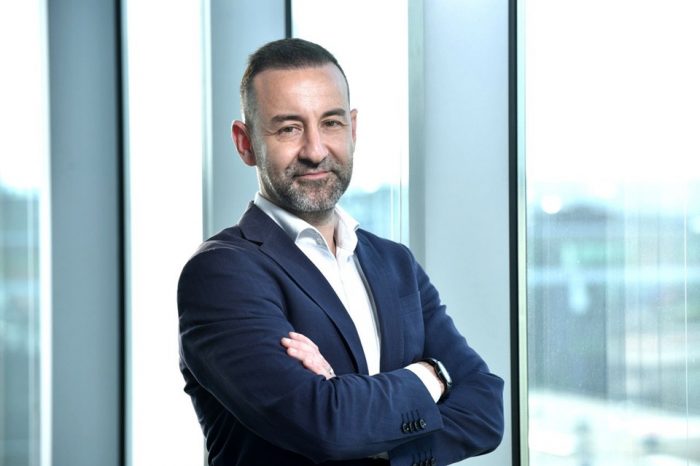
🎙️Costin Teodorovici, Co-founder & CTO Realtynno: Organizations become hybrid by design — combining humans, AI and systems into one integrated operational model
 Magda Purice
Posted On April 15, 2026
Magda Purice
Posted On April 15, 2026

Outsourcing Today, the business services industry’s integrated networking and news platform, continues its interview series with leaders shaping the future of business services and related sectors. We explore key perspectives on the year ahead, strategic priorities, and growth opportunities.
Read below the key standpoints and perspectives of Costin Teodorovici, Co-founder & CTO Realtynno
🎙️AI-based technologies changing the company’s competitive edge in 2026
AI has not changed what we do; it has fundamentally changed how fast and how well we do it.
In our case, the competitive edge comes from compressing the entire value chain: from understanding a client’s problem, to designing a solution, to actually delivering and iterating on it. Tasks that used to take days or weeks — research, structuring, prototyping, even parts of development — now happen in hours, with better consistency.
More importantly, AI allows us to operate at a much higher level of focus. Our teams spend significantly less time producing raw output and much more time making decisions, refining architecture, and building business logic. That shift compounds over time. The result is not just efficiency. It’s a different kind of company: one that can move faster, adapt faster, and deliver more tailored solutions without increasing complexity or overhead.
🎙️Misconceptions about AI
I think business leaders — and frankly most people using AI tools today — no longer question its advantages. The real confusion is around what AI actually does well and what it doesn’t. We still see both extremes: severe understatement and unrealistic expectations. Both come from the same place — lack of hands-on use.
There is no shortcut here. The only way to understand AI is to use it daily and integrate it incrementally into real processes. Some areas see immediate gains, others don’t move at all.
The good news is that the ecosystem is evolving fast — new models, better tools, lower costs — so the surface where AI adds real value is expanding month by month.
No business decisions in our companies are AI-led — they are AI-backed. Any mature decision sits at the end of a process: data, analysis, summaries, predictions. AI is extremely good at supporting all of that.
On top of that, you still need business judgment, intuition, and the willingness to take risks. That layer remains human — and that’s exactly how it should be.
🎙️AI impacting customers’ expectations
Clients don’t always realize how AI has changed their expectations, but they feel it.
They expect faster delivery, more flexibility and a much better overall experience. Waiting days for answers or iterations is no longer acceptable when they know it can be done in hours.
More importantly, they expect software to do actual work. Not just store or display data, but actively assist in processing it — extracting information from documents, generating outputs, suggesting next steps, even handling parts of execution.
There is also a growing expectation of context awareness. Clients don’t want to repeat the same inputs or re-explain their business logic at every step. They expect systems to remember, adapt and respond based on prior interactions and real business data.
Another shift is in customization. AI has lowered the cost of tailoring solutions, so clients increasingly expect products to adapt to their workflows — not the other way around.
The result is a fundamental repositioning: software is no longer seen as a static tool, but as a working partner that can take over repetitive, high-volume and high-stress tasks, while leaving control and decision-making to the user.
🎙️Staying differentiated in the market
We’ve learned where AI actually adds value and built our processes around that. Every member of the team — from leadership to interns — uses AI as a daily amplifier. That allows us to spend less time producing output and more time creating value.
Internally, AI helps us stay organized — structuring discussions, tracking decisions, keeping execution tight. In sales, it enables highly targeted research and tailored proposals — no more generic outreach.
In engineering, the shift is even more visible: less time writing code, more time designing systems, defining architecture and expanding business capabilities.
🎙️Balacing rapid innovation with responsible and ethical AI use
We don’t see AI as something separate from ethics — it’s just another layer of tooling. Ethics and legality have always been the foundation of sustainable businesses, and that doesn’t change with AI. What AI does is amplify decisions. If the underlying intent is sound, it scales well. If not, it fails faster and louder.
That’s why responsibility doesn’t sit with the technology — it sits with the people using it.
🎙️Technology in trending now
Beyond AI and agentic, which are already centric to what we do, we are watching three major technology layers evolve. First, digital twins — real estate and infrastructure are becoming live, data-driven systems that can be monitored and optimized in real time. Second, edge computing combined with IoT software is no longer isolated; it’s directly connected to the physical world, enabling instant decisions and automation. Third, the API economy — platforms are becoming orchestration layers that connect multiple systems into one seamless experience.
At a broader level, we see three major shifts. We are moving into an execution economy, where software is expected to actually do work, not just store data.
We are seeing the decline of generic software, replaced by highly customizable systems tailored to each client. And finally, organizations are becoming hybrid by design — combining humans, AI, and systems into one integrated operational model. These shifts are redefining not just technology, but how companies are built and how they compete.