From an INACO pilot project to over 1,300 SmartLabs in Romania
 Magda Purice
Posted On September 8, 2026
Magda Purice
Posted On September 8, 2026
Seven years ago, the INACO Association – Initiative for Competitiveness launched the first SmartLab in Romania, in a pilot project built with private funding and with the ambition to demonstrate that technology can become a real tool for transforming education.
Today, 1,294 smart labs have been built in high schools in Romania through the National Recovery and Resilience Plan (PNRR), and together with the laboratories built through private initiatives and funding, Romania has exceeded the threshold of 1,300 Smart Labs. What started in 2019 as an educational experiment of INACO has thus become a model taken over at the level of public policies and multiplied on a national scale.
“We knew that technology had to reach schools. Not as a decoration, but as a tool through which children learn, create and have equal opportunities in the future. We chose to build for the Romania to come. INACO tested the model. Romania multiplied it. Now the impact stage begins“, says Andreea Paul, founder of INACO – Initiative for Competitiveness and initiator of the SmartLab project.
From a crowdfunding experiment to a national model
In 2019, when INACO inaugurated the first SmartLab 4.0 at Gymnasium School no. 45 “Titu Maiorescu” in Bucharest, the idea of smart digital laboratories reaching schools across the country seemed unrealistic to many.
The initial objective was a visionary one: the access of students in Romania to educational spaces equipped with state-of-the-art technologies, where learning would be centered on experimentation, creativity, collaboration and the development of the skills necessary for the economy of the future.
This was followed by the first laboratories, successively developed by INACO together with public and private partners: at the “Alexandru Ioan Cuza” Theoretical High School in Bucharest, Magurele Science Park, the “Grigore Moisil” Theoretical High School, the “Alexandru Odobescu” County Library in Calarasi, the Secondary School in Bucov – the first SmartLab in the Romanian countryside – and the “Nicolae Kretzulescu” Higher Commercial School in Bucharest.
The model was tested, adapted and perfected before being multiplied on a national scale.
In March 2022, the SmartLab project was named the winning innovative project of the year 2021 and awarded at Avanti’s Awards, within BETT, the largest global event dedicated to educational technologies.
From the experiment and demonstration stage to the systemic multiplication stage
The validation of the model through the pilot projects developed by INACO has created the premises for the expansion of smart laboratories through public funding.
Through the PNRR, the concept went from the experiment and demonstration stage to the systemic multiplication stage, with 1,294 smart laboratories being built in high schools in Romania. Thus, an initiative started by civil society contributed to the definition of an educational model that could be extended nationwide.
“It is one of those situations in which an idea born in a pilot project manages to overcome the limits of the organization that initiated it and enter the area of public policies. For us, this is one of the most important results of the SmartLab project: not only have we built laboratories, but we have demonstrated that another way of doing education is possible,” says Andreea Paul.
The experiences of schools already using these laboratories confirm the potential of the model:
At the “Henri Coandă” Theoretical High School in Craiova, two Smart Labs are used for different fields – mathematics-computer science and linguistics – and allow the integration of technology in STEM activities, programming, modeling, communication and language learning.
At the Darmanesti Technological High School in Bacău County, teachers talk about increasing students’ interest in science and technology, developing critical thinking and creativity and a more active involvement in collaborative projects.
At the “Petru Rareș” Technological High School in Botoșani, the SmartLab combines digital technologies with professional training, including by using a car simulator for students from the Auto Mechanic and Agricultural Mechanic qualifications.
And at the “Vasile Alecsandri” National College in Bacău, the project also generated multiplier effects among teachers: teacher Marin Iulian Benchea, one of the initial beneficiaries of the project, was later involved in the training of over 500 teachers from ten high schools in the county.
“An educational project does not end when the equipment is delivered. That’s when it starts,” Andreea Paul emphasizes.
Next challenge: from infrastructure to impact
The expansion to over 1,300 SmartLabs is an important milestone, but not the end of the project. For INACO, the next stage is to capitalize on the full potential of the network of smart laboratories, through their constant use in the teaching process, teacher training, exchange of best practices, collaboration between schools and connection of educational communities.
The stake is no longer just for schools to have access to technology, but for this technology to be used relevantly, creatively and consistently to develop the skills that students need in an economy undergoing an accelerated transformation.
“This is what excites me the most after almost 10 years. Not the equipment. But the fact that an idea born in a school in Bucharest, improved in other schools, has reached schools all over Romania. And that teachers and children have started to give them their own lives. The mission, however, is not over. From 1 to 1,300 is not the end of the story. It is the beginning of a new stage”, explains Andreea Paul.
From the first SmartLab in 2019 to over 1,300 laboratories in 2026, the project’s route demonstrates that educational innovation can start from civil society, be tested in communities, validate through results, and become a model for public policies on a national scale.
The more than 1,300 Smart Labs represent the infrastructure. The next stage is to build the educational ecosystem that capitalizes on them.
For INACO, SmartLab remains a growing project: a network of spaces, teachers, students and communities that can collaborate, learn and innovate together.
More images from the SmartLabs can be accessed in the video – https://youtu.be/3cyMbD4uQq8
******************************************************************************
What is a SmartLab
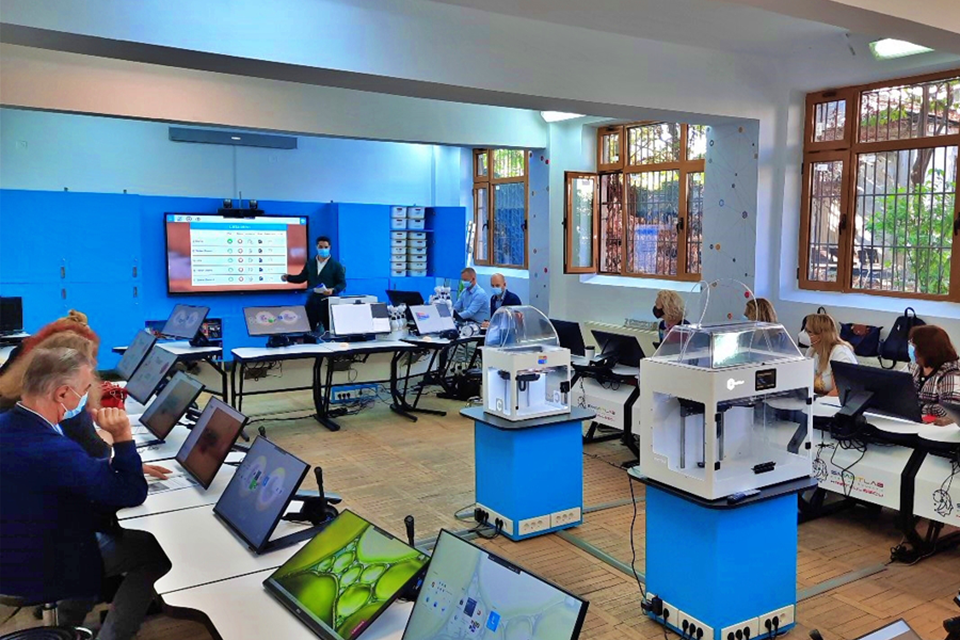
A SmartLab is a multifunctional educational space where technology is used to support active learning and the development of digital, technical, creative and entrepreneurial skills.
Educational robots, 3D printers and scanners, 3D pencils, virtual reality glasses, interactive whiteboards, high-performance computers, educational software, video streaming systems and other technologies can be integrated into activities in mathematics, computer science, foreign languages, arts or technological disciplines.
Through SmartLab, students are encouraged to experiment, build, test, make mistakes and find solutions. The teacher expands his role as a transmitter of information and becomes a facilitator of learning, and the school can become a space for exploration and innovation.
INACO – The Competitiveness Initiative is a non-profit community of managers, consultants, analysts, experts in the economic and educational fields, connected to the network of specialists in the state and private economy in Romania. INACO supports through analysis, investigation, research and proposal of solutions to raise the level of economic competitiveness of public institutions and the business environment in Romania.
Other initiatives include the Guide to the Jobs of the Future, the Romanian Competitiveness Index, the Digital Education Pact, the “Stop gifts in school!” campaign and the “Romania of the Future” series of strategic reports.
photo credits: Smart Lab