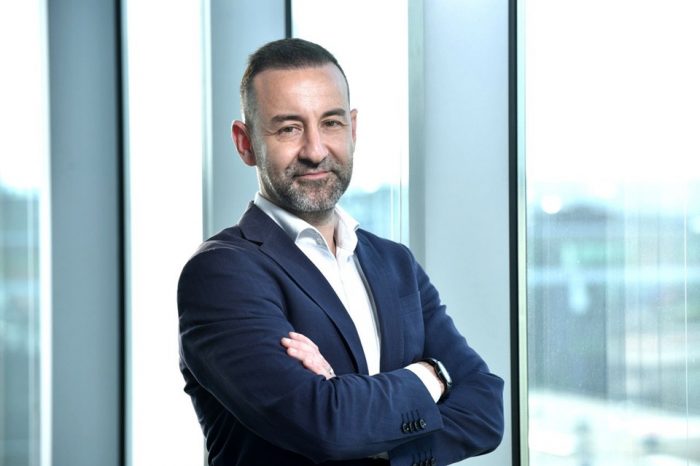
🎙️Mihai Toma, Enterprise Account Executive SAP Romania: AI has shifted SAP’s competitive advantage from transactional efficiency to decision enablement and execution at scale
 Magda Purice
Posted On March 4, 2026
Magda Purice
Posted On March 4, 2026

Outsourcing Today, the business services industry’s integrated networking and news platform, continues its interview series with leaders shaping the future of business services and related sectors. We explore key perspectives on the year ahead, strategic priorities, and growth opportunities.
Read below the key standpoints and perspectives of Mihai Toma, Enterprise Account Executive SAP Romania.
AI is changing SAP’s edge by moving us beyond recording transactions to helping companies decide and act in real time—safely, at scale, and inside the processes that run their business.
AI-based technologies changing the company’s competitive edge in 2026
AI has shifted SAP’s competitive advantage from transactional efficiency to decision enablement and execution at scale. By embedding AI directly into core business processes—finance, supply chain, HR and procurement—SAP is transforming its applications from systems of record into systems of action. Domain-specific models trained on structured enterprise data, combined with end-to-end process visibility, allow SAP to deliver more precise, explainable and governable outcomes than general-purpose AI platforms.
Therefore, this approach strengthens SAP’s position against point solutions and AI-first vendors, particularly in regulated and complex global enterprises. In 2026, SAP competes less on features and more on trusted automation, process ownership and measurable business outcomes.
The biggest misconception business leaders still have about AI
I would say it is the belief that buying AI alone is enough, without changing how decisions are made. AI doesn’t transform businesses—leadership does.
The most persistent misconception is treating AI as a plug-in technology rather than an operating capability. Many organizations invest in tools without redesigning processes, decision rights or accountability. As a result, AI can accelerate existing inefficiencies instead of transforming outcomes. Successful adoption requires leadership decisions about which decisions are delegated to machines, how humans and artificial intelligence collaborate, and how performance is measured. AI transformation is primarily a management challenge, not an IT one.
Business decisions impacted by AI
At SAP, AI doesn’t replace leadership—it runs the repeatable decisions so our people can focus on the ones that truly matter.
For several years, SAP has used AI to lead high-frequency, repeatable data-intensive decisions across different departments such as sales (pipeline prioritization), pricing governance, financial monitoring and customer support, just to mention a few. AI sets priorities, triggers actions and executes within predefined guardrails, while humans retain ownership of strategy and irreversible decisions. This model improves speed, consistency and scale while preserving accountability. SAP internally applies the same AI operating model it promotes to customers.
How did AI change the customers’ expectations
Our customers no longer ask SAP to show them the data—they expect us to help them decide and act on it.
AI has shifted customer expectations from transactional efficiency to decision support and execution. Customers now expect SAP to recommend actions, explain outcomes, adapt continuously and automate work—not merely record data. Usability standards have risen sharply, with natural language and minimal training assumed. AI has also reduced tolerance for complexity and weak ROI. SAP is increasingly judged as a business operating partner, not just a software provider.
How do you stay differentiated in your market, what tools and competitive advantages do you leverage in 2026?
You know, anyone can build AI features. Very few can embed intelligence into the full operating backbone of the enterprise.
SAP’s differentiation rests on end-to-end process ownership, deep industry expertise and trusted AI embedded directly into core workflows. Unlike point solutions, SAP provides cross-functional visibility and control at global scale. Structured enterprise data, industry-specific models, the Business Technology Platform and strong governance form a strong competitive barrier.
Balancing rapid innovation with responsible and ethical AI use
At SAP we don’t slow innovation to be responsible—we build responsibility so innovation can scale.
SAP balances innovation and responsibility by embedding AI within governed processes, enforcing human oversight for high-impact decisions and prioritizing explainability and auditability. Central AI principles define risk boundaries, while product teams innovate freely within them. Strict data governance and sovereignty protections preserve customer trust, particularly in regulated industries. Responsible AI is positioned not as a constraint, but as an enabler of scalable adoption.
From my perspective, the future does not belong to the most autonomous AI, but to the most trusted. Our focus is embedding intelligence into real business processes—where accountability, transparency and governance already exist.
SAP differentiates its AI strategy by prioritizing trust over speed. AI is embedded inside governed business processes, not deployed as free-form automation. High-volume, reversible decisions are increasingly AI-led, while regulatory, financial and people-impacting decisions remain human-owned. Strong explainability, auditability and data-sovereignty controls are built in by design. This approach limits experimentation at the edge but enables safe scaling at the core. In regulated, global enterprises, responsible AI has become a prerequisite for adoption—and a competitive advantage.
What technology trend beyond AI should businesses be paying attention to now?
Well, the AI revolution is still in its early stages, and the applicability is immense. It would be difficult to say for sure even where this would lead. Imagine that in the 19th century, the engine was invented. In a few years people probably imagined different scenarios for the future but not really the world we are living in now.
However, just as the engine needs energy to function and is critical to people and countries’ security, AI will also lead to a world where energy as well as data quality, and data residency would be the key to a bright future. Beyond AI, the most consequential technology trend for enterprises is digital sovereignty and regulations: control over where data, workloads and critical systems operate, and under which jurisdictions.
Geopolitical tension, regulation, and cyber risk are exposing the fragility of highly centralized, globally dependent technology stacks. Therefore, this may become increasingly regionalized and regulated in the near future.