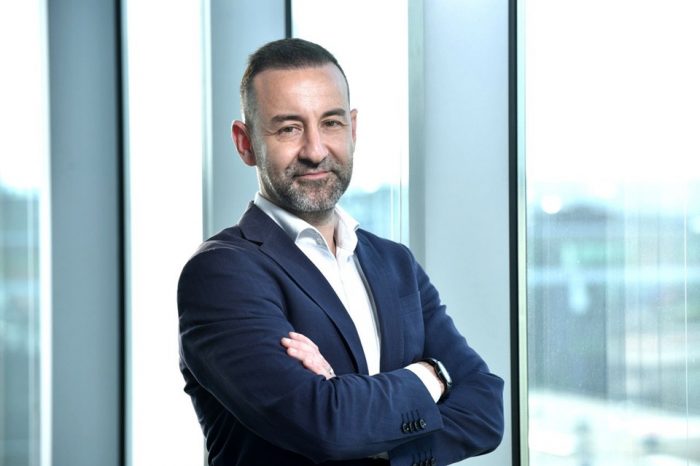
🎙️Liviu Tudor, president and founder of Genesis Property: We are testing and gradually introducing AI-enabled analytics where the value is clear and measurable
 Magda Purice
Posted On February 19, 2026
Magda Purice
Posted On February 19, 2026

Outsourcing Today, the business services industry’s integrated networking and news platform, continues its interview series with leaders shaping the future of business services and related sectors. We explore their perspectives on the year ahead, strategic priorities, and growth opportunities.
Read below the key standpoints and perspectives of Liviu Tudor, president and founder Genesis Property.
The words of 2026: Relevance. Responsibility. Resilience.
These reflect our focus on staying connected to real tenant needs, acting responsibly toward communities and the environment, and building resilient strategies that perform under change.
AI-based technologies changing the company’s competitive edge in 2026
In 2026, AI is strengthening our competitive edge primarily through the way we understand markets, communicate, and position our projects. We use AI extensively in marketing and communications to improve content relevance, campaign performance, and audience insight, helping us act faster and with greater precision across channels.
Beyond marketing, our approach is selective and pragmatic. We are testing and gradually introducing AI-enabled analytics where the value is clear and measurable – especially in building performance monitoring, reporting, and early-stage predictive insights. Rather than “AI everywhere”, we focus on specific use cases that support efficiency, sustainability targets, and a better tenant experience, while keeping human control and accountability at the centre.
What’s the biggest misconception business leaders still have about AI?
One major misconception is that AI is either a shortcut to instant transformation or simply an automation tool for cost cutting. In practice, sustainable value comes when AI is embedded into well-defined processes, supported by reliable data, and governed responsibly.
Another misconception is treating AI as a one-off implementation. Real results require iteration, clear ownership, continuous calibration, and robust governance – particularly around data security, privacy, and quality. When these foundations are in place, AI can meaningfully enhance planning and decision-making without replacing leadership or strategic judgment.
AI-led Business decisions
We don’t consider decisions to be “AI-led.” Decisions remain management-led and are ultimately owned by people. Where we use AI, it is to inform decisions with better analysis and faster visibility.
Today, our most mature use is in marketing and communications—optimising messaging, segmentation, and performance. In operations, we are running targeted pilots and analytics initiatives related to energy monitoring, consumption patterns, and scenario evaluation, where the data supports it. We see AI as a decision-support layer that improves clarity and responsiveness—especially in complex, multi-tenant environments—while maintaining human oversight and accountability.
AI changing the customers’ expectations
AI has accelerated expectations around speed, responsiveness, and transparency. Tenants and their employees increasingly expect clear information, more personalised communication, and visible progress on sustainability performance.
In real estate and campus environments, this translates into a stronger focus on experience: consistent comfort, proactive services, and credible reporting. AI helps us meet these expectations first through improved communications and insight; and, progressively, through more advanced performance analytics where appropriate. We are careful not to overpromise “fully autonomous” buildings—our priority is reliability, service quality, and measurable outcomes.
Tools and competitive advantages leveraged in 2026
Our differentiation comes from combining long-term investment discipline with a strong people-centric vision for campuses. Technology – including AI – supports that strategy, but it is not the strategy itself.
We invest in smart infrastructure, energy efficiency, and sustainability initiatives that can be tracked and improved over time. Equally important, we focus on the community dimension: integrated ecosystems that include green areas, services, and social infrastructure that improve everyday life and help companies attract and retain talent. In an uncertain market, stable delivery, adaptability, and credible ESG progress remain decisive advantages.
Balancing rapid innovation with responsible and ethical AI use
We balance innovation with responsibility by being deliberate about where AI is used, and by keeping governance and human oversight in place. Data security, privacy standards, and clear accountability are non-negotiable.
We also prioritise use cases that support our broader ESG commitments – improving efficiency, reducing environmental impact, and enhancing user experience – while avoiding experimentation that creates unnecessary operational or reputational risk. Responsible innovation is, for us, a long-term trust strategy.
What technology trend beyond AI should businesses be paying attention to now?
Beyond AI, energy technologies and smart infrastructure are becoming central to competitiveness – particularly for large-scale developments. Intelligent energy management, renewable integration, and advanced metering are increasingly strategic, both for cost resilience and for sustainability requirements.
In parallel, digital twins and lifecycle building analytics are gaining momentum, enabling owners and operators to plan, optimise, and modernise assets with greater precision over time. Combined with selective AI use, these trends can materially improve efficiency, resilience, and long-term performance.