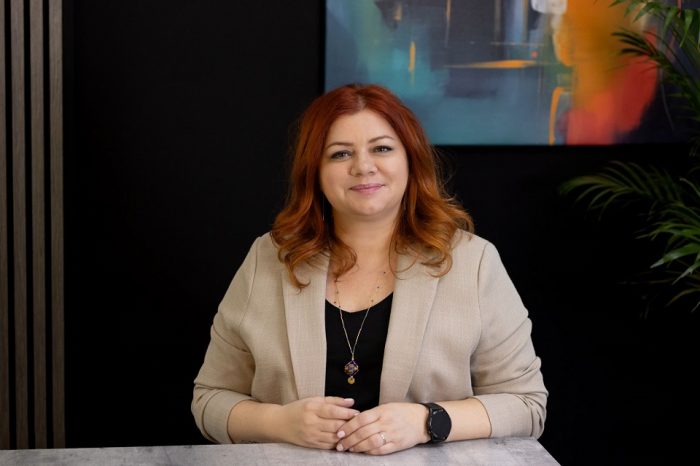
Roxana Epure, NextUp: Romanian companies are digitalizing to reduce the effects of external unpredictability. Frequent fiscal changes in the past have reduced the business environment’s trust in state institutions
 Magda Purice
Posted On July 30, 2025
Magda Purice
Posted On July 30, 2025

Of course, tax increases are not wanted by anyone, but what puts strong pressure on Romanian SMEs is the lack of predictability. The frequent tax changes in the past, which prevented entrepreneurs from creating an investment plan and blocked the activities of some companies until their disappearance, led to a lack of trust in state institutions, warns NextUp, a software company in contact with over 6,000 SMEs. However, in this context, the digitalization and automation of operations have become the primary solution through which more and more companies can maintain control and direction. Entrepreneurs also expect real digitalization from state institutions.
Increasing taxes, high operational costs with bureaucracy, and a lack of fiscal predictability are driving more and more entrepreneurs to automate key processes: from accounting and invoicing to inventory management, integration with ANAF, and real-time tracking of cash flow.
Through business reports generated by an integrated information system, entrepreneurs have total clarity about what works in the business, what doesn’t work, and where quick decisions are needed, educated decisions based on numbers, not intuition. That’s why, in 2025, 300% more entrepreneurs joined the NextUp user community, eager to streamline their costs.
They understood that equipping themselves with ERP software is a cost that they can quickly cover by streamlining internal processes, by reducing the consumption of resources to fix mistakes, and by automating administrative work that does not bring real added value to their companies.
“When you can’t control the external environment, the solution is to have relevant indicators at a click. Know, not believe. When you don’t invest, you not only stagnate, but you also lose opportunities. And during this time, your competitors are taking the right steps. We recommend that entrepreneurs in Romania create leverage by making educated decisions based on numbers. To make multiple scenarios, starting from the possible tax changes that are circulating in the press. To build a possible solution for each scenario, a plan of action like in chess: if the move X comes from outside, I will do Y, and so on. This is the only way you can keep up. In addition, the level of anxiety decreases, which is caused by the expectation of doing nothing, of waiting to see what happens. Luck does not belong to those who wait, but to those who prepare and act on time,” Roxana Epure, founder and Managing Partner of NextUp, a developer of ERP solutions for SMEs, says.
The digitalization of the private environment must be doubled by the digitalization of the state
More and more companies are making significant efforts to automate their activities and reduce exposure to errors or delays caused by bureaucracy. However, the relationship with state institutions remains cumbersome, bureaucratic, and lacking digital coherence.
“The business environment also expects real digitalization from the state. For me, as a producer of integrated software for local businesses, it is essential to see that Romania maintains the direction of digitalization of public institutions. Our goal, as those who build ERP solutions and digital systems for companies, should coincide with that of the state: to reduce the consumption of resources and time on papers, queues, and redundant reporting. If both parties – the private and public environments – pull in the same direction, Romania truly becomes an efficient space for business,” Roxana Epure, Managing Partner NextUp, emphasizes.
A digitalized administration would mean lower costs, faster response times, fewer errors, and a predictable business environment based on collaboration rather than bottlenecks. In addition, companies could allocate the saved resources to investment, development, and innovation, thus contributing to increasing state revenues.
Automation, a condition for business development
In a volatile economic context, digitalization with the right software is no longer just a competitive advantage, but an essential condition for business survival and development. More and more companies, including those that until recently operated with outdated or completely manual systems, are rethinking their way of working and looking for ERP solutions adapted to their specific needs.
“We see an increased interest from entrepreneurs in digitalization. They realize that they can no longer afford to spend on mistakes, to delay or make decisions blindly, to have operational costs with bureaucracy. They want to see in real time what their expenses are, who the customers are in arrears, how the goods are moving, where money is being lost, and, above all, where to intervene in time to avoid declines, to avoid missing opportunities.
“Smart software such as ERP is no longer just for corporations – it is, more recently, a necessity for SMEs. Digitalization is still a luxury, especially since equipping with such software can be done at whatever pace we want, both in terms of effort and cost. For better or worse, the ability to automate human tasks, without errors, is an added value. And when you decide based on numbers, you do business in an educated and preventive way. In 2025, companies that do not digitalize risk falling behind their competitors,” Roxana Epure adds.
According to NextUp, in the last year, more and more companies in trade, distribution, production, or services have switched to integrated systems that allow them to:
● Automate their workflows – reducing time wasted on repetitive tasks
● Have accurate and fast tax reporting, including integrations with ANAF
● Track their receipts, payments, margin, and stocks in real time
● Make decisions based on numbers, not intuition
Even if companies cannot control taxes or government decisions, they can control how they manage their resources and information. And here, digitalization plays a decisive role.
In conclusion, although taxes remain a hot topic in 2025, adaptation through digitalization and active risk management are the elements that can make the difference between stagnation and growth for Romanian companies. NextUp is the developer of an integrated and modular IT software that saves entrepreneurs time with bureaucracy, such as e-Invoice. NextUp software is adapted to local businesses and is used primarily in online retail, traditional retail, manufacturing, distribution, construction, and services to automate resource-consuming repetitive activities and optimize business processes and forecasts. NextUp has over 6,000 customers, with an average of 5 users